Dunbar
Dunbar lies on the North Sea coast, around 30miles (48km) east of Edinburgh and a short distance from the English border north of Berwick-Upon-Tweed.
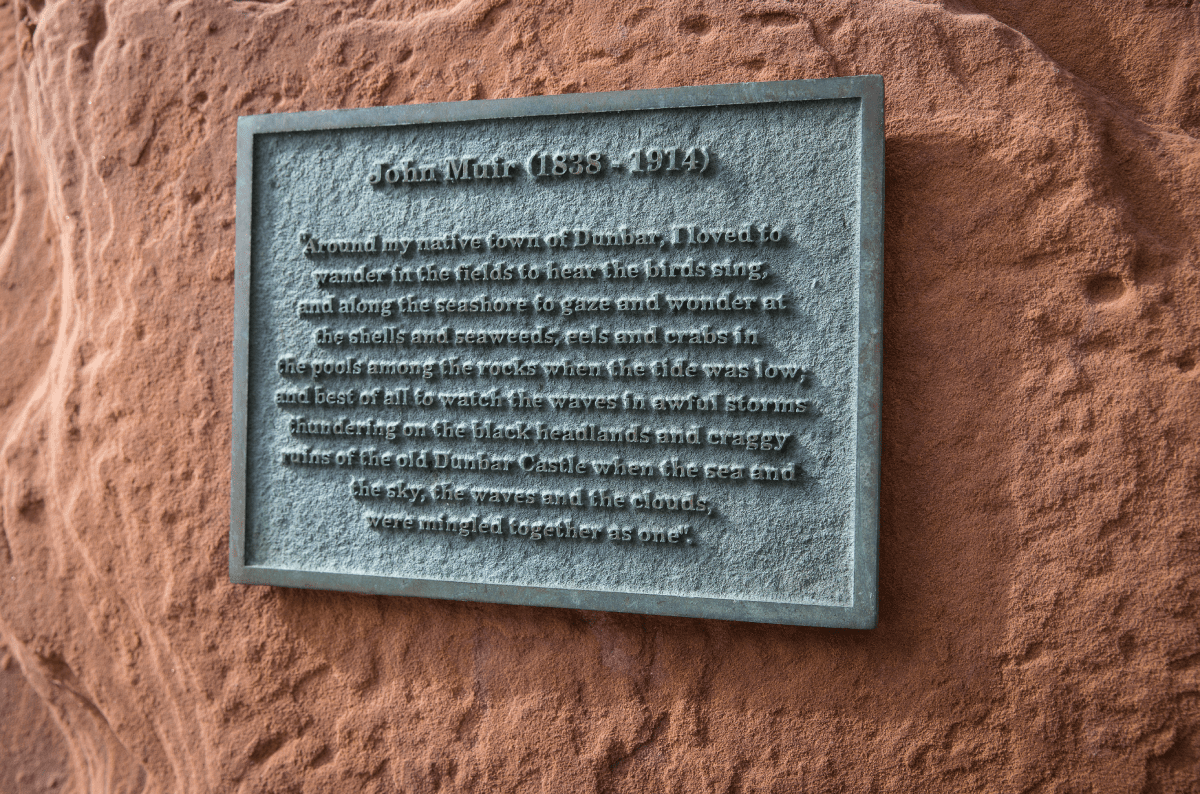
Dunbar is famed as the birthplace of John Muir who was born here on 21 April 1838. He emigrated to the USA aged 11 with his family in search of a better life. John Muir went on to become an inspirational environmentalist and conservationist and is known as the Father of America’s National Parks. Throughout his writings, Muir often reflected on his childhood in Dunbar and how the town's coastline and countryside inspired his lifelong passion for nature.
Dunbar has a great fishing heritage and today it still has two harbours; Victoria and Cromwell. For centuries, herring known as the ‘silver darlings’, formed the backbone of the local fishing industry. The catch was carried by fishwives in creels on their backs along the Herring Road to Lauder in the Scottish Borders for sale - a round trip of 58miles (90km).
The ruins of Dunbar Castle sit at the entrance of Victoria harbour. The ruins of Dunbar Castle have witnessed many significant events in Scotland's history.
The first battle in the Scottish Wars of Independence in 1296 was fought a few miles to the south-west of the castle and ended with an English victory. Following Robert the Bruce’s victory at Bannockburn in 1314, Edward II fled from the battlefield to the relative safety of Dunbar Castle.
But perhaps the most dramatic story is that of Black Agnes, Countess of Dunbar. She was born in 1312, the daughter of Robert the Bruce’s nephew, Thomas Randolph, and married to the 9th Earl of Moray. In 1337 only Agnes and a few men were residing in the castle when the English set out to capture it. During a five-month siege beginning in January 1338, Black Agnes and her small garrison successfully defended the castle against repeated English attacks, earning her a lasting place in Scottish history.
Mary, Queen of Scots, sought refuge in Dunbar Castle in 1566 following the murder of her private secretary, David Rizzio. The following year, after the murder of her second husband, Lord Darnley, she became closely associated with James Hepburn, Earl of Bothwell. Following her defeat at the Battle of Carberry Hill in June 1567, Bothwell fled into exile while Mary was imprisoned and later forced to abdicate. Dunbar Castle was subsequently ordered to be destroyed by the Scottish Parliament.
In September 1650, a Scottish army of 22,000 was defeated by a Cromwellian force, of half the size, at the Battle of Dunbar. Cromwell went on to take Edinburgh which led to Scotland becoming part of the Commonwealth of England, Scotland and Ireland in 1653.
Known as Scotland's sunniest town, Dunbar is a popular visitor destination, offering a spectacular coastline, beautiful beaches, rich history and rolling countryside. Dunbar's broad, accessible High Street is home to an excellent selection of independent shops, cafés, restaurants and local businesses.
What to see and do
gallery